



 Polski
 English
 Italiano
 Español
 Čeština
 Српски
 Deutsch
 Ελληνικά
 Slovenský




-
€
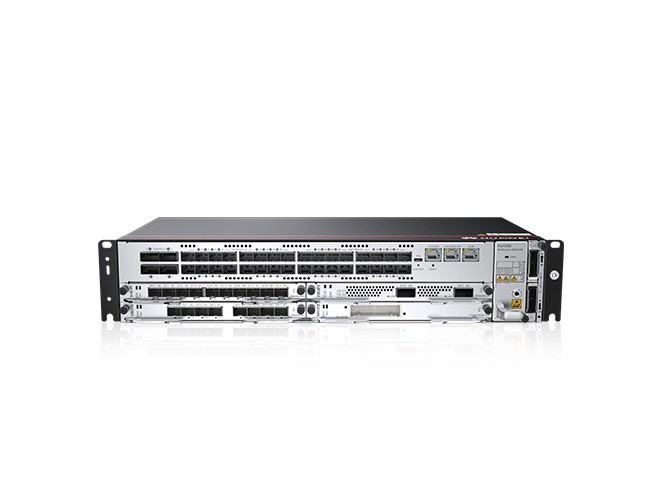
Huawei NetEngine 8000E M4 router 2x 100GE or 8x 25GE + 16x 10GE, DC power supply
Price
0,00 €
0,00 € incl. tax
favoriteAdd to wishlist
The Huawei NetEngine is a high-performance router housed in a 2U chassis. Depending on the configuration, it can handle up to 405 million packets per second (Mpps) while maintaining a maximum power consumption of 283.4 W. The available throughput and interface types depend on the installed license. The ports are divided into four sections, and the device is equipped with a total of 4 ports supporting 100G / 50G and 16 ports supporting 25G / 10G. With the appropriate expansion card and license, the system can also support 400G interfaces. The exact functionality depends on the selected configuration. The package includes the VSUP-100 board—a dedicated VAS (Value-Added Services) card that offloads the main processor and enables advanced, resource-intensive configurations. This board serves as the core of the entire system, handling functions such as NAT traffic processing.
Example Configuration
Below is an example of a popular configuration widely used by Internet service providers. If you would like to modify any of the components, please contact us. This is a project-based product intended for ISP deployments.
Interfaces: Combo group (selectable as 2 × 100G or 8 × 25G) + 16 × 10G ports.
Additional board: VSUP-100 (integrated Value-Added Services board).
Power supply: DC. An AC-powered version is also available. Please note that AC power supply modules occupy slots intended for service boards, limiting the maximum number of installed service boards to 2 instead of 4.
Licences:
100G port licenses (enable 100G interfaces)
N1-N8KEM4AP-LIC – N1-NetEngine 8000E M4 Series Advanced SW Function Package. This is the primary system license. The Advanced edition unlocks the full feature set without software restrictions.
N1-N8KM4BNG-LIC – N1-NetEngine 8000 M4 Series BNG Function. Enables L2TP, PPPoE, IPoE, EDSG, and DAA functionality. The default licensed capacity supports up to 32,000 subscribers.
N1-N8KM4NATS-LIC – N1-NetEngine 8000 M4 Series Integrated Service Card CGN Service 1M NAT Session. Each license adds 1 million NAT sessions. The example configuration includes six of these licenses, providing a total capacity of 6 million NAT sessions (licensed for the VSUP-100 board).
CR8SCGN10GC0 – Throughput license that adds 10 Gb/s of processing capacity to the VSUP board. Without additional licenses, the default throughput is limited to 20 Gb/s. The example configuration includes seven of these licenses, increasing the total throughput to 90 Gb/s.
Specifications
| Huawei NetEngine 8000E M4 | |
| Switching Capacity | 2.4 Tb/s |
| Forwarding Performance | 405 Mp/s |
| Maximum Board Capability | 400 GE |
| Interface types | 400G / 100GE / 50E / 40GE / 25GE / 10GE / GE / FE / E1 / cPOS / POS |
| Main Control Board | Single |
| M.2 Flash Storage | 16 GB |
| Service Slots | 4 |
| Dimensions | 442 mm x 220 mm x 88.9 mm (2U) |
| Typical Power Consumption | 283.4 W |
| Voltage |
DC: -48 / -60 V AC: 200 V to 240 V/100 V to127 V dual live wires, support 240 V HVDC |
| Clock | 1588v2, 1588 ATR, 1588 ACR, G.8275.1, Synchronous Ethernet |
| Temperature | DC: –20°C to +60°; AC: –20°C to +55°C |
| Maximum Number of Routes (FIBv4 / FIBv6) |
Up to 8M / 4M |
| Maximum Number of IPsec Tunnels |
20000 |
| Features | |
|---|---|
| System Management |
LAD LLDP System Time NTP SNMP NETCONF BootLoader Management Device Management Information Management Fault Management Performance Management DCN RMON SAID PADS CUSP KPI VS |
| Clock and Time Synchronization |
Physical-Layer Clock Synchronization 1588v2 G.8275.1 CU-106 SMPTE-2059-2 C37.238 1588 ATR CES ACR Atom GPS Atom GNSS Atom GPS 3.0 |
| Network Reliability |
Intra-chassis High Availability BFD VRRP VRRP6 Ethernet OAM LPT Dual-Device Backup Bit-Error-Triggered Protection Switching MPLS OAM MPLS-TP OAM |
| Interface and Data Link |
Interface Management Port Extension Fiber Health Care (FHC) |
| LAN Access and MAN Access |
MAC Ethernet Interface Eth-Trunk Interface GVRP, Layer 2 Protocol Tunneling VLAN QinQ EVC ERPS (G.8032) MAC Flapping-based Loop Detection STP_RSTP_MSTP RRPP BPDU Tunneling VXLAN |
| WAN Access |
ATM IMA E-Carrier Interface CPOS Interface FR HDLC and IP-Trunk LMSP POS Interface PPP PRBS Testing TDM WDM Interface Serial Interface Delay Compensation |
| IP Services |
ARP ND ACL ACL6 DHCP DHCPv6 DNS IPv6 DNS MTU IPv4 Basic IPv6 Basic Load Balancing |
| IP Routing |
Basic IP Routing IPv4 Static Route IPv6 Static Route OSPF OSPFv3 RIP RIPng IS-IS BGP BGP4+ Routing Policy XPL Route Monitoring Group |
|
IP Multicast |
IGMP PIM MSDP MBGP IPv4 Multicast Routing Management IPv6 Multicast Routing Management Rosen MVPN NG MVPN BIER BIERv6 MLD IPv6 PIM User-side Multicast Controllable Multicast Multicast NAT Layer 2 Multicast Timestamp-Refresh |
| MPLS |
Common MPLS MPLS TE MPLS LDP Seamless MPLS GMPLS UNI |
| Segment Routing |
Segment Routing MPLS (SR MPLS) Segment Routing IPv6 (SRv6) |
| Application Awareness | APNv6 |
| Path Control | PCEP |
| VPN |
VPN Tunnel Management GRE DSVPN L2TPv3 BGP/MPLS IP VPN BGP/MPL IPv6 VPN VPLS VPWS IP Hard Pipe L2VPN Accessing L2VPN L2VPN Accessing L3VPN EVPN PBB-EVPN PBB VPLS Loop Detection |
| QoS |
Traffic Policing Traffic Shaping Congestation Management Congestation Avoidance Class-based QoS Policy-based Routing QPPB HQoS MPLS DiffServ Mode SRv6 DiffServ Mode QoS User Access Multicast QoS VPN QoS Deterministic IP Networking |
| Security |
AAA and User Management ARP Security DHCP Snooping DHCPv6 Snooping GTSM Keychain TCP-AO URPF Local Attack Defense MACsec SOC Packet Header Obtaining BGP Flow Specification Xsec IPsec PKI Mirroring Layer 2 Traffic Suppression MPAC 802.1X Port-based Authentication Security Risk Query SAVA-X System Master Key SSL SSH FIPS HTTPS HIPS Weak Password Dictionary Maintenance Weak Security Algorithm Disabling Trusted System EULA |
| System Monitoring |
IP FPM NetStream NQA Ping Tracert gRPC Telemetry TWAMP TWAMP Light STAMP sFlow IFIT EMDI ESQM Flow Recognition Intelligent Monitoring In-depth Flow Analysis Path Detecion EVA Remote Packet Header Obtaining |
| User Access |
IPv4 Address Management IPv6 Address Management IPoE Access PPPoE Access 802.1X Access L2TP Access User Access Multi-Device Backup EP Escape |
| NAT and IPv6 Transition |
NAT L2NAT DS-Lite PCP NAT64 CGN Reliability MAP IPv4 over IPv6 Tunnel IPv6 over IPv4 Tunnel |
| Value-Added Services |
BOD DAA EDSG Data Redundancy Elimination |
Other products in the same category that you may find interesting: