



 Polski
 English
 Italiano
 Español
 Čeština
 Српски
 Deutsch
 Ελληνικά
 Slovenský




-
€
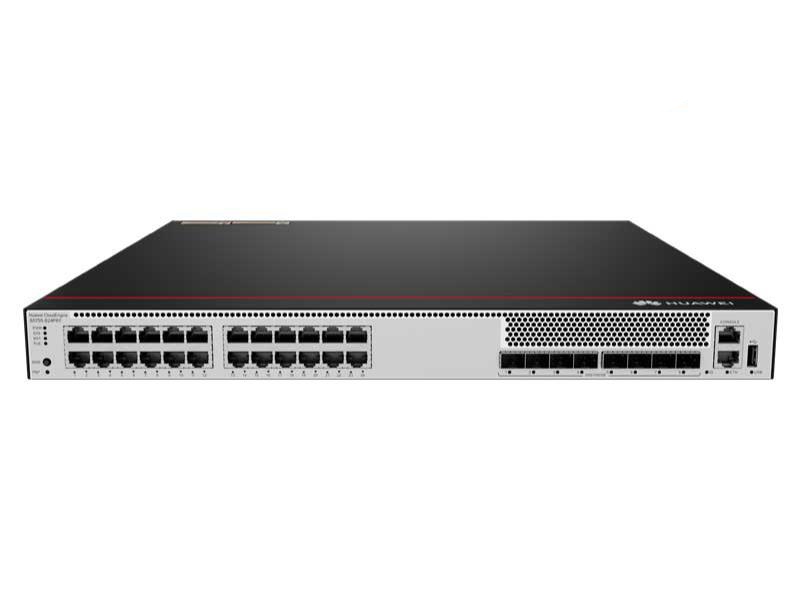
Huawei CloudEngine S5755-S24P8Y switch L3, 24x GE, 8x SFP28, 24x PoE+ (840 W), 2x AC 600 W power supply
Price
2 186,81 €
2 689,78 € incl. tax
favoriteAdd to wishlist
Huawei CloudEngine S5755-S24P8Y is an enterprise-class managed switch. It is equipped with 24 × 1G Ethernet ports and 8 × SFP28 slots (25 Gb/s bandwidth). All Ethernet ports provide PoE+ power output (802.3af/at). The output power per port depends on the standard and is 15.4 W for 802.3af or 30 W for 802.3at. The total power budget (for all ports) with two 600 W power supplies and 220 V input voltage is 840 W. The switch offers advanced management features, including Layer 3 capabilities. It supports traditional STP protocols (STP / RSTP / MSTP) as well as ERPS for loop protection. To ensure uplink connection reliability, the switch uses Smart Link and VRRP (Virtual Router Redundancy Protocol). An additional advantage is iStack, which allows multiple devices to be connected in a virtual stack, simplifying the management of larger networks and improving scalability. The device stands out with high performance, featuring a quad-core 1.2 GHz processor and 4 GB of RAM. The switching capacity is 448 Gb/s. The package includes two 600 W AC power supply modules.
Specifications
| Huawei S5755-S24P8Y | |
| Hardware | |
|---|---|
| Dimensions (H x W x D) |
43,6 x 442 x 420 mm |
| Chassis height | 1U |
| Chassis weight (including packaging) |
6.93 kg |
| Fixed port | |
| 1G Ethernet ports | 24 |
| SFP28 ports | 8 |
| Management port | |
| ETH port | Supported |
| Console port (RJ45) | Supported |
| USB | USB 2.0 |
| CPU | |
| Frequency | 1.2 GHz |
| Cores | 4 |
| Storage | |
| RAM | 4 GB |
| Flash | 1 GB |
| Power supply system | |
| Power supply type | 600 W AC (pluggable) |
| Rated voltage range |
AC: 100 - 120 V AC, 200 - 240 V AC, 50/60 Hz HVDC: 240 V DC |
| Maximum voltage range |
AC: 90 - 290 V AC, 45 - 65 Hz HVDC: 190 - 290 V DC |
| Maximum power consumption | 100% traffic under the ATIS standard, dual power modules, and without PoE: - 62 W (all ports used) - Full PoE load, three 1000 W power modules: 975 W (PoE: 840 W) |
| Typical power consumption | 30% traffic under the ATIS standard, dual power modules: 60 W |
| Static power consumption | 29 W |
| Heat dissipation system | |
| Heat dissipation mode | Air cooling for heat dissipation, intelligent fan speed adjustment |
| Number of fan modules | 2, built-in |
| Airflow | Air intake from front, air exhaustion from rear (front-to-rear) |
| Maximum heat dissipation of the device (BTU/hour) |
100% traffic under the ATIS standard, dual power modules, and without PoE: - 211.55 (all ports used) - Full PoE load, three 1000 W power modules: 3326.75 |
| Environment parameters | |
| Long-term operating temperature |
0-1800 m: -5°C to 45°C 1800-5000 m: The operating temperature decreases 1°C every time the altitude increases 220 m |
| Short-term operating temperature |
0-1800 m: -5°C to 50°C 1800-5000 m: The operating temperature decreases 1°C every |
| Storage temperature | -40°C to +70°C |
| Relative humidity | 5%–95% (non-condensing) |
| Operating altitude | 5000 m |
| Noise under normal temperature (sound power) | 30% load: 52.2 dBA |
| Surge protection specification (power port) | AC power port: ±6 kV in differential mode, ±6 kV in common mode |
| Reliability | |
| MTBF | 109.32 years |
| MTTR | 2 h |
| Availability | > 0.99999 |
| Software | |
| User management |
Unified user management 802.1X authentication, MAC authentication, Portal authentication Traffic- and duration-based accounting User authorization based on user groups, domains, and time ranges Jumbo-frame |
| MAC |
330000 MAC(Max) Automatic MAC address learning and aging Static, dynamic, and blackhole MAC address entries Source MAC address filtering MAC address learning limiting based on ports and VLANs |
| VLAN |
4K VLANs simultaneously 4K VLANif interface simultaneously Access mode, Trunk mode and Hybrid mode Default VLAN Private VLAN QinQ and enhanced selective QinQ VLAN Stacking Dynamic VLAN assignment based on MAC addresses VLAN-based ACL (VACL) |
| ARP | ARP Snooping |
| IP routing |
Static Route, Routing Policy, Policy-Based Routing ECMP, URPF VRF IPv4 dynamic routing protocols such as RIP v1/v2, OSPF v1/v2, IS-IS, and BGP IPv6 dynamic routing protocols such as RIPng, OSPFv3, ISISv6, and BGP4+ Up to 256K FIBv4 entries (MAX) Up to 128K FIBv6 entries (MAX) IPv4/IPv6 dual stack IPv4 ping, IPv4 tracert, and IPv4 Telnet IPv6 ping, IPv6 tracert, and IPv6 Telnet |
| Segment Routing |
SRv6 BE (L3 EVPN) BGP EVPN SRv6 configuration through NETCONF |
| Multicast |
IGMPv1/v2/v3 and IGMP v1/v2/v3 Snooping PIM-DM, PIM-SM, and PIM-SSM Fast-leave mechanism Multicast traffic control Multicast querier Multicast protocol packet suppression Multicast VLAN, Multicast Static MAC |
| QoS |
Traffic classification based on Layer 2 headers, Layer 3 protocols, Layer 4 protocols, and 802.1p priority Actions such as ACL, Committed Access Rate (CAR), re-marking, and scheduling Queuing algorithms, such as PQ, DRR, and PQ+DRR Congestion avoidance mechanisms such as WRED and tail drop Traffic shaping 8 queues on each interface Network Slicing(VLAN/VxLAN/SRv6) |
| Ethernet loop protection |
STP (IEEE 802.1d), RSTP (IEEE 802.1w), and MSTP (IEEE 802.1s). VLAN-based Spanning Tree (VBST) BPDU protection, root protection, and loop protection G.8032 Ethernet Ring Protection Switching (ERPS) |
| Reliability |
M-LAG Service interface-based stacking Maximum number of stacked devices: 9 Stack bandwidth (Bidirectional) Link Aggregation Control Protocol (LACP) Virtual Router Redundancy Protocol (VRRP) and Bidirectional Forwarding Detection (BFD) for VRRP BFD for BGP/IS-IS/OSPF/static routes Eth-OAM 802.1ag(CFM) Smartlink LLDP, LLDP-MED |
| System management |
Console terminal service Telnet/IPv6 Telnet terminal service SSH/SSHv2/HTTP/HTTPS/Telnet SNMP v1/v2/v3 SFlow FTP, TFTP, SFTP BootROM upgrade and remote in-service upgrade Hot patch User operation logs Open Programmability System (OPS) Streaming Telemetry iFlow(Intelligent Flow) Registration Center Deployment WebMaster Management Terminal identification, Application identification |
| Security and management |
NAC Port-security RADIUS and HWTACACS authentication for login users Management by Command Line Interface(CLI) Command line authority control based on user levels, preventing unauthorized users from using command configurations Defense against DoS attacks, Transmission Control Protocol (TCP) SYN Flood attacks, User Datagram Protocol (UDP) Flood attacks, broadcast storms, and heavy traffic attacks IPv6 RA Guard CPU hardware queues to implement hierarchical scheduling and protection for protocol packets on the control plane Remote Network Monitoring (RMON)/SMON Secure boot MACsec (IEEE 802.1ae) Deception Port isolation, port security, and sticky MAC Port mirroring Native-IP IFIT (iPCA2.0), Netstream, NQA, Telemetry Dynamic ARP Inspection IP Source Guard RSPAN |
| Interface Management | IEEE 802.3bz |
Other products in the same category that you may find interesting: